
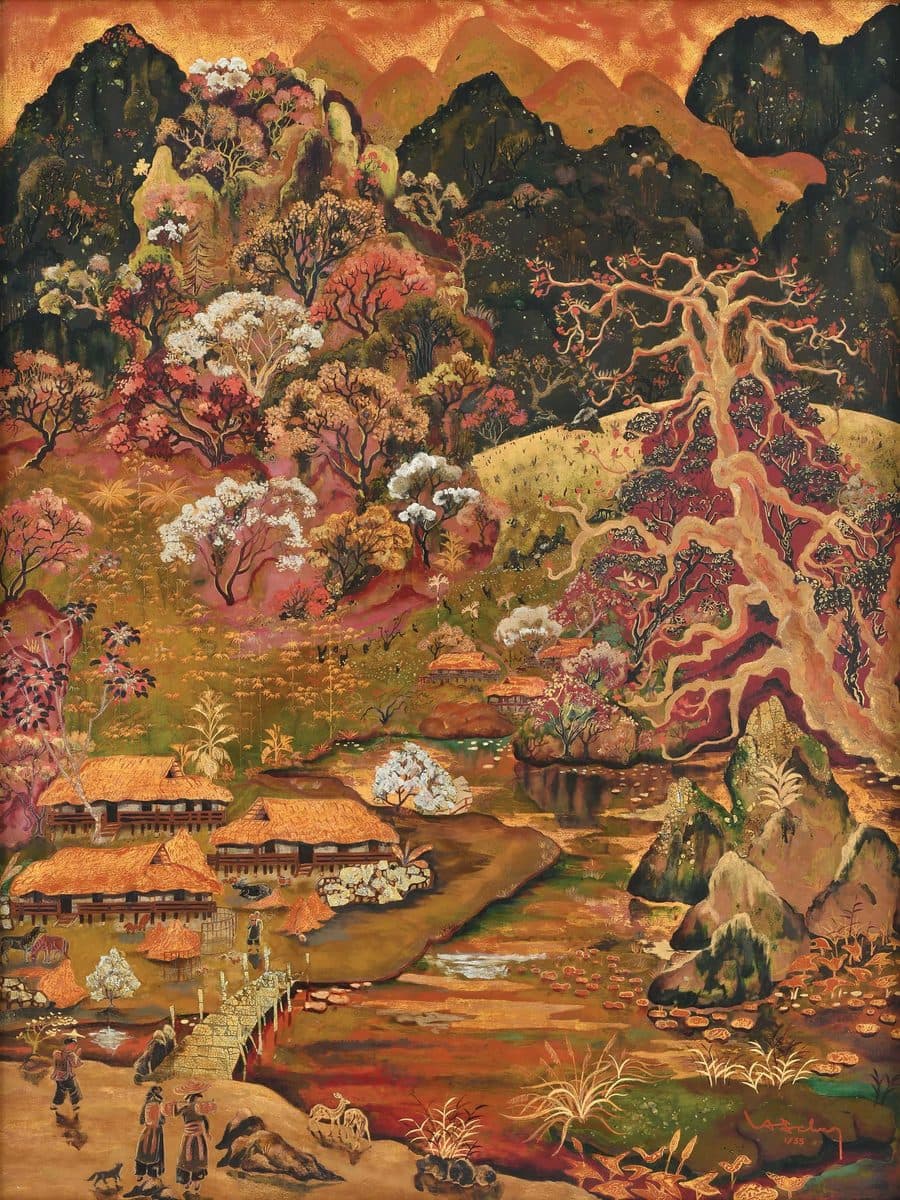
- Maker
- Hoàng Tích Chù
- Date
- 1955
- Medium
- Lacquer on board
- Collection
- Private collection
- Licence
- Public domain
- Source
- Wikimedia Commons
Lacquer, a craft material, turned into a painting medium — in Vietnam, in 1955.
Sơn mài is Vietnamese lacquer painting, and it began as a furniture and shrine craft: resin from the lacquer tree, built up in many layers over board, with eggshell, gold and silver leaf set into it, then sanded and polished back until the buried layers surface.
In the 1930s a group of painters at the École des Beaux-Arts de l'Indochine in Hanoi began pushing it towards fine art, and Hoàng Tích Chù was among the figures who carried that through. The problem they were solving is specific: lacquer is opaque, slow, and worked in reverse — the artist builds up and then removes to find the image, which is closer to printmaking or intaglio than to painting wet on wet.
This landscape is dated 1955, on board. The palette is the traditional one, and largely unavoidable given the chemistry — the deep browns and blacks of the resin, cinnabar red, gold and silver leaf — but the composition is a modern easel picture rather than a decorative panel.
The date is worth pausing on. In 1955 Vietnam had just come through Điện Biên Phủ and the Geneva Accords, and the country had been divided at the seventeenth parallel the year before. A landscape painted in that moment, in a medium being consciously argued into the status of national art, is not a neutral object.
The work is in a private collection.