
Singapore · 15 of 15
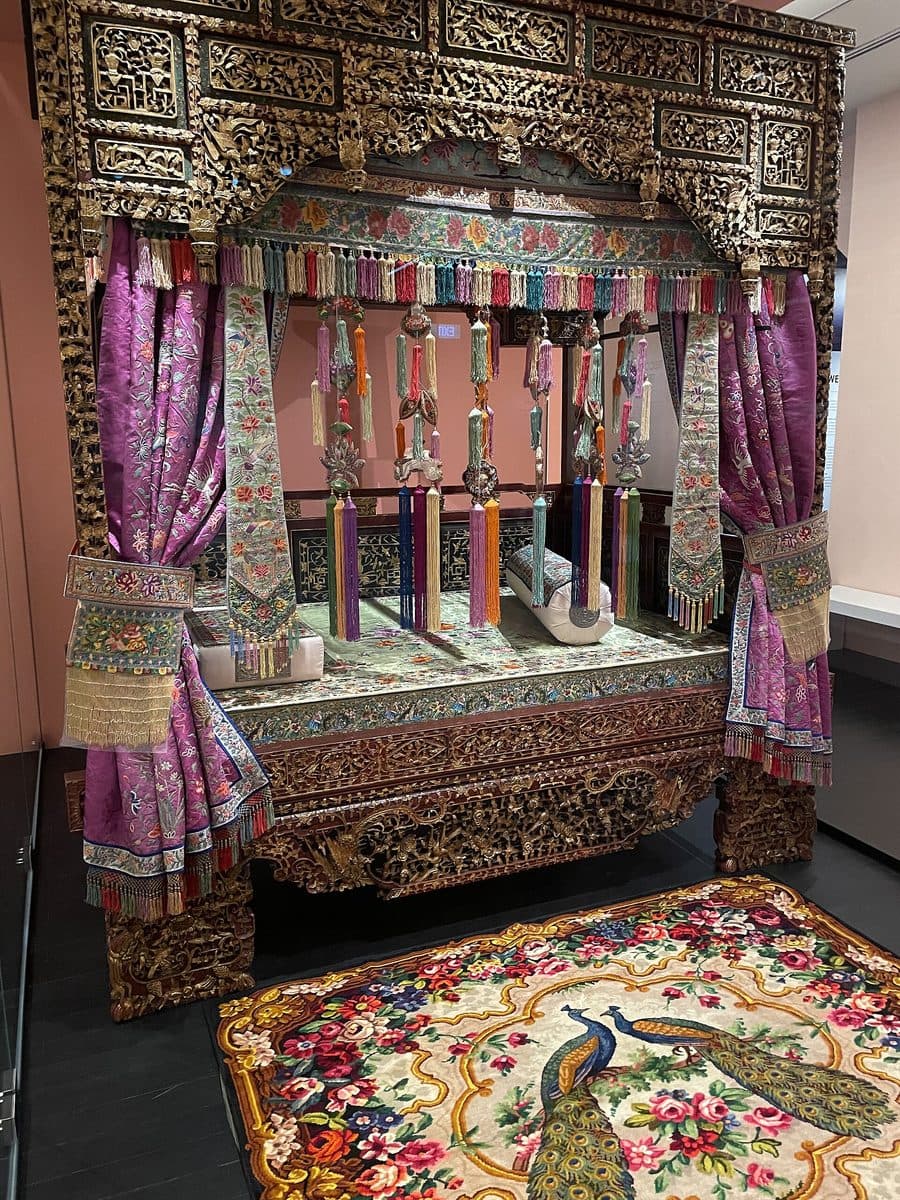
Peranakan bridal chamber
Makers not named in the record · Object undated; photographed 2023
- Maker
- Makers not named in the record
- Date
- Object undated; photographed 2023
- Medium
- Carved and gilded wood, embroidered textiles
- Collection
- Peranakan Museum, Singapore
- Photograph
- Sgconlaw · CC BY-SA 4.0
- Licence
- CC BY-SA 4.0
- Source
- Wikimedia Commons
A gilded bed, embroidered hangings, and a wedding that used to take twelve days.
The photograph shows a Peranakan bridal chamber as installed at the Peranakan Museum in Singapore: a carved and gilded bed, textile hangings worked in dense colour, a peacock embroidered across the front.
Peranakan — Straits Chinese — culture came out of centuries of intermarriage and settlement between Chinese migrants and local communities across Malacca, Penang and Singapore, and it is legible in exactly this kind of object. The furniture form and the auspicious symbolism are Chinese; the beadwork and embroidery traditions, the textiles and the domestic vocabulary draw on Malay and wider regional practice; and the whole thing is later inflected by European taste under colonial rule. It is not a blend of two things. It is its own thing.
The bridal chamber sat at the centre of a wedding that, at its most elaborate, ran twelve days, with the chamber itself prepared, dressed and displayed as part of the ceremony. The furnishing was not background. It was on show, and the quality of the embroidery was read as a statement about the household.
A note on the record: the Commons file identifies this only as an artefact in the Peranakan Museum, photographed in 2023 by the contributor Sgconlaw. It carries no accession number, no date for the object, and no maker. What is described above is the object type and the practice around it, which the image supports; anything more specific about this particular piece would be invention.