
Korea · 9 of 15
Temple Guardian, Protector of the Law
Unrecorded painter · 19th century, Joseon dynasty
- Maker
- Unrecorded painter
- Date
- 19th century, Joseon dynasty
- Medium
- Colour on paper, height 130 cm
- Collection
- Musée Guimet, Paris
- Photograph
- Ismoon · CC BY-SA 4.0
- Licence
- CC BY-SA 4.0
- Source
- Wikimedia Commons
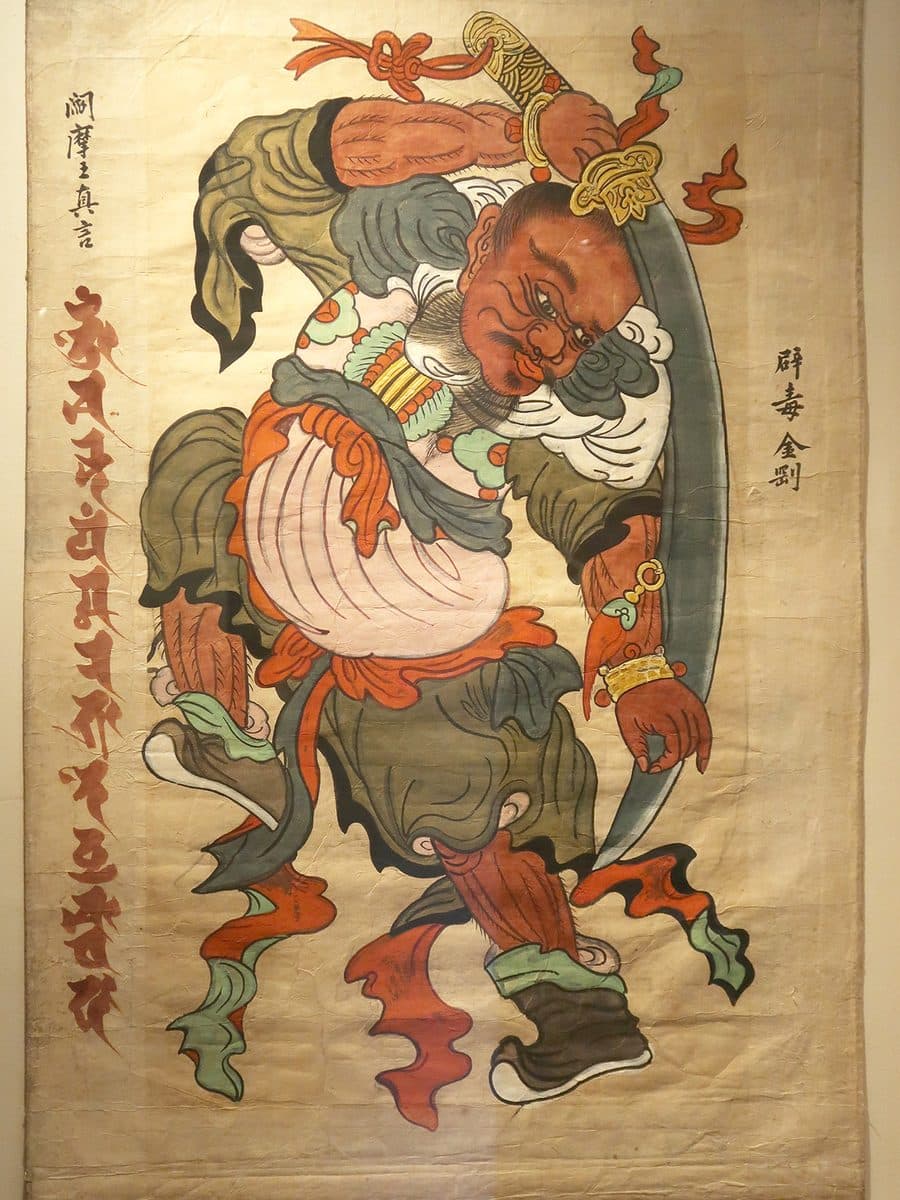
A painted banner of a guardian who protects the teaching, from nineteenth-century Korea.
This is a Buddhist banner: colour on paper, about a hundred and thirty centimetres tall, made to be hung rather than framed. The figure is a temple guardian — a protector of the dharma, part of the class of deities Korean Buddhism absorbed and put to work at the threshold.
Guardians occupy a specific position in the architecture of a temple. They are at the gate, on the walls, at the edges of the ritual space, facing outward. Their job is not to be contemplated the way a Buddha image is; it is to be intimidating in the direction of whatever might be coming. The style follows the function — high colour, exaggerated musculature, a scowl, weapons, movement.
The handling here is Joseon-period and confident, with heavy outline and flat, saturated fields of red and green over a pale ground. The brush is quick where the drapery moves and slow where the face is. Inscriptions in the upper corners identify the figure.
The Joseon dynasty is not the period one expects for grand Buddhist commissions. The state was Neo-Confucian and Buddhism spent centuries pushed out of official favour, sustained instead by rural temples and lay patronage. That this banner is a nineteenth-century work is a reminder that the tradition kept going the whole time, at a scale the court was not funding.
It is now in the Musée Guimet in Paris. The photograph is by the Wikimedia contributor Ismoon.