
India · 11 of 15
Sri Shanmukha Subrahmanya Swami
Ravi Varma Press, after Raja Ravi Varma · Undated; the press operated from 1894
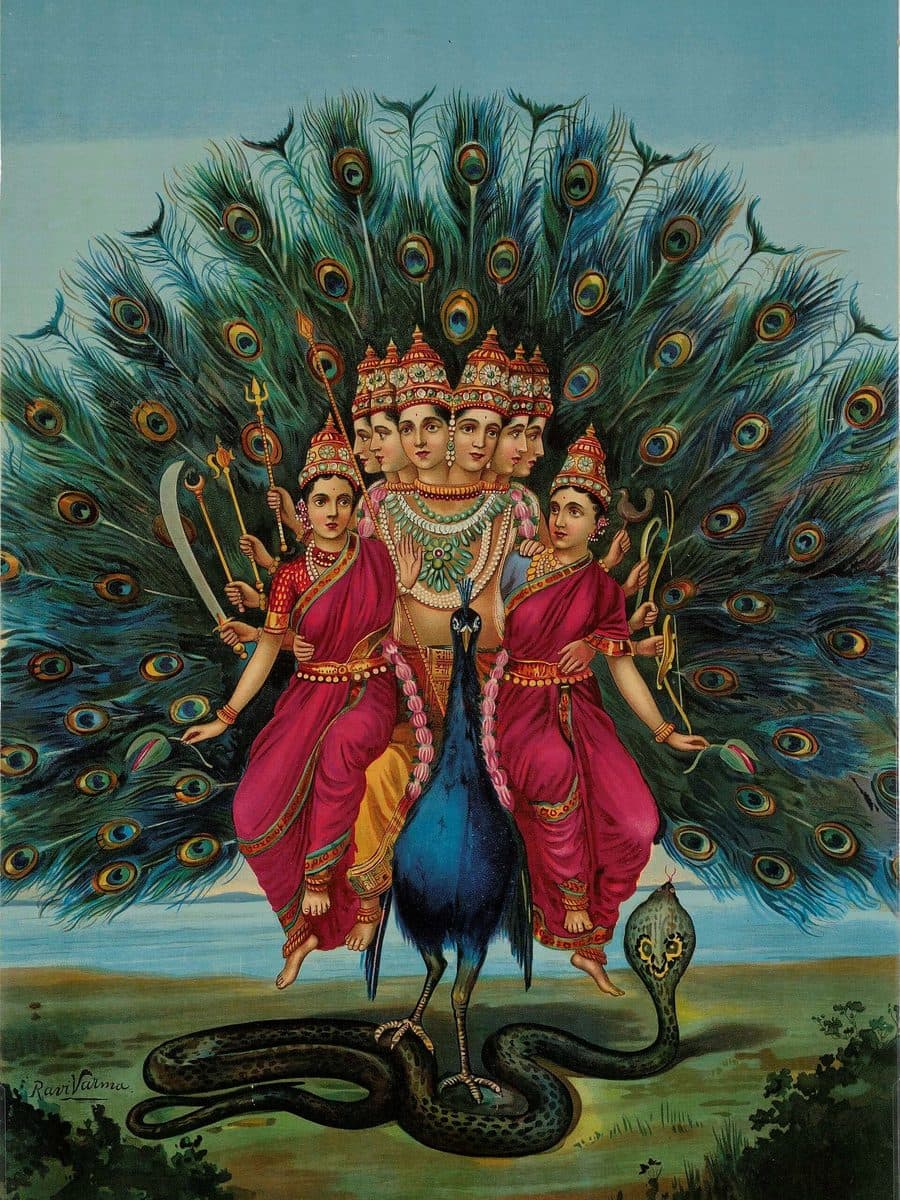
- Maker
- Ravi Varma Press, after Raja Ravi Varma
- Date
- Undated; the press operated from 1894
- Medium
- Oleograph
- Collection
- Published by C. Cunniah & Co., Madras
- Licence
- Public domain
- Source
- Wikimedia Commons
A god printed by the thousand — the press that put deities on the walls of ordinary houses.
This is not a painting. It is an oleograph, a lithographic colour print made to look like an oil, issued by the Ravi Varma Press and published by C. Cunniah & Co. of Madras. The subject is Murugan — Karttikeya, Subrahmanya — with his consorts, mounted on his peacock.
Raja Ravi Varma was the most celebrated Indian painter of the nineteenth century, and his real intervention was not any single canvas but the decision to industrialise. He set up a press in 1894 to reproduce his religious compositions cheaply and at volume. The prints sold for very little and went everywhere.
The effect was enormous and genuinely double-edged. On one side, darshan — the act of seeing and being seen by the deity — stopped requiring a temple or a patron. A household of no means could have an image on the wall. On the other, a mass-produced picture standardises. Regional iconographies that had varied considerably began converging on the press's version, and a great deal of what now reads as the traditional appearance of these gods is in fact the look of late-nineteenth-century commercial lithography.
Varma himself painted in a European academic manner — modelled flesh, receding landscape, theatrical staging — so what was distributed was also a particular hybrid, Hindu subject in Salon technique.
The file carries no date. The press began operating in 1894 and Varma died in 1906; prints under this imprint continued well after him.