
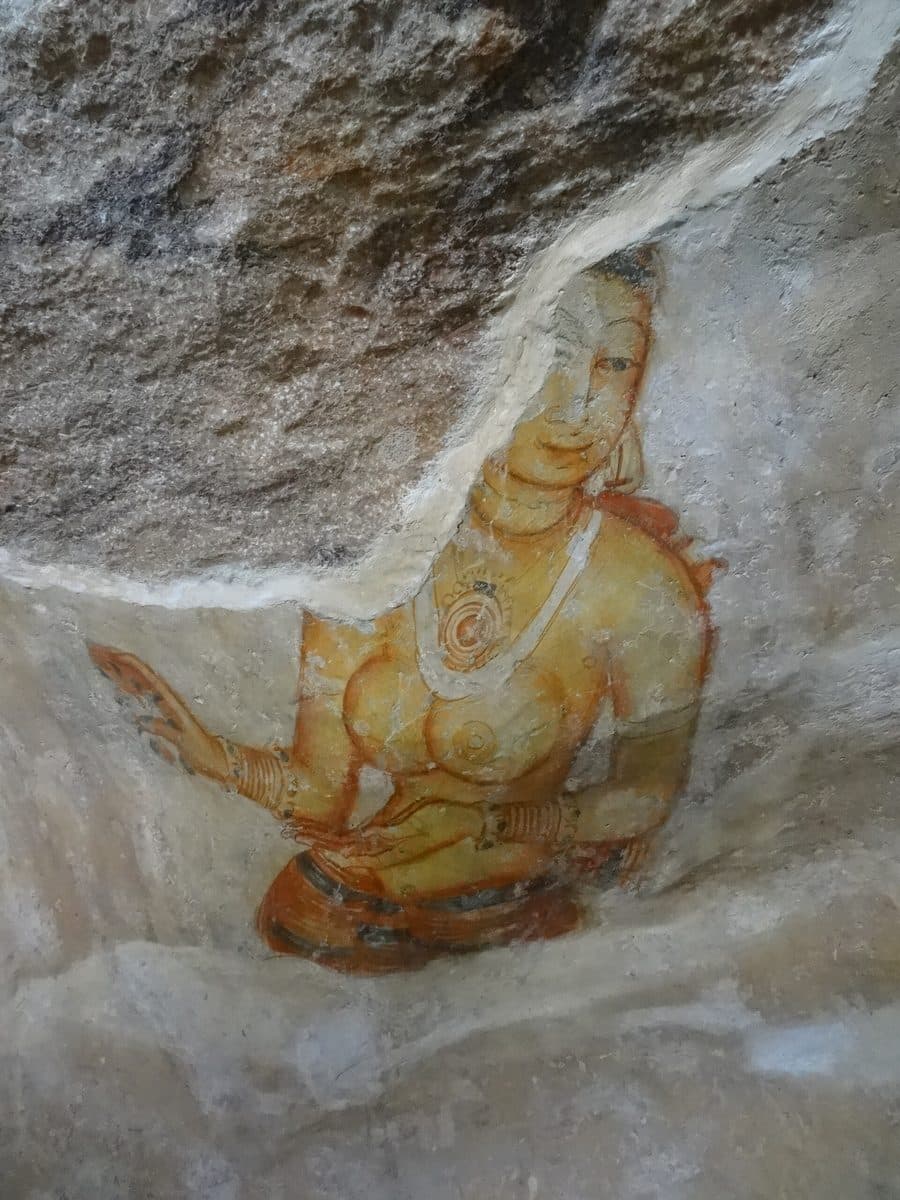
- Maker
- Unrecorded painters
- Date
- 5th century
- Medium
- Pigment on plaster
- Collection
- Sigiriya rock fortress, Central Province
- Photograph
- Cherubino · CC BY-SA 3.0
- Licence
- CC BY-SA 3.0
- Source
- Wikimedia Commons
Women painted onto a sheer rock face in the fifth century, in a pocket of stone the weather never reached.
Sigiriya is a column of hardened magma rising two hundred metres out of the Sri Lankan plain, and in the fifth century King Kassapa I put a citadel on top of it. On the way up, in a sheltered depression of the west face, painters covered the rock in figures of women — jewelled, bare-shouldered, holding flowers, emerging from what look like clouds.
What survives is a fragment. Early accounts describe a painted band running far along the rock; roughly twenty figures remain, preserved by the overhang that kept the rain off them. The rest went to weather, to vandalism, and to time.
Nobody agrees on who they are. They have been read as apsaras, as ladies of Kassapa's court on their way to worship, and as personifications of cloud and lightning. The painters left no names and no explanation, and the debate has run for more than a century without resolving.
What is not in dispute is the handling. The figures are modelled in warm earth pigment with a confidence that assumes an established tradition rather than an experiment — these are not a first attempt at anything. They sit at the head of the South Asian painting lineage that later runs through Ajanta and beyond, and they were made for an audience of almost nobody, high on a rock, visible only to those who made the climb.