
Japan · 7 of 15
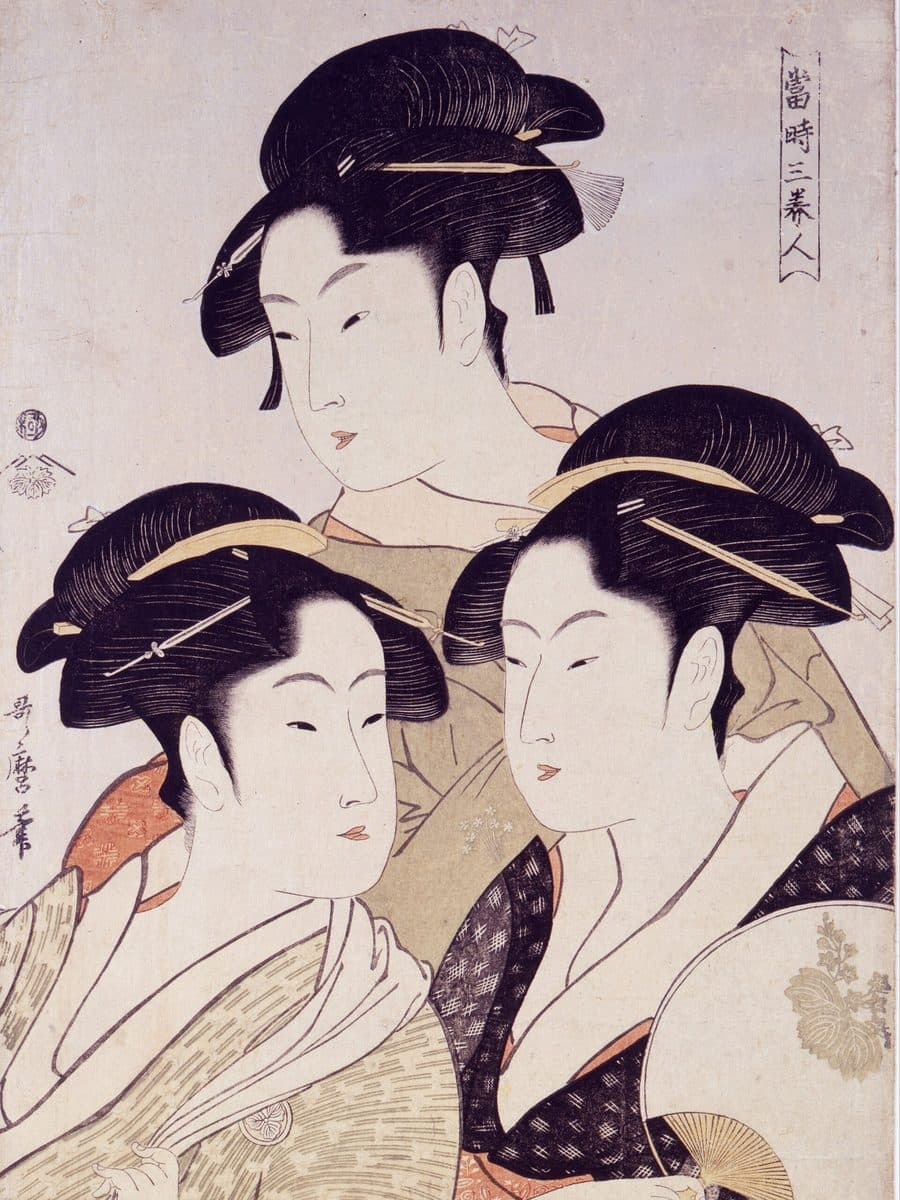
Three Beauties of the Present Day (当時三美人)
Kitagawa Utamaro · c. 1793
- Maker
- Kitagawa Utamaro
- Date
- c. 1793
- Medium
- Woodblock print (nishiki-e), published by Tsutaya Jūzaburō
- Collection
- Digitised via Google Arts & Culture
- Licence
- Public domain
- Source
- Wikimedia Commons
Three real women of 1790s Edo, drawn as individuals at a time when beauty was drawn as a formula.
The print names them, and the names mattered: Tomimoto Toyohina, a geisha; Naniwaya Okita, who served tea in Asakusa; and Takashimaya Ohisa, from a teahouse family. These were public figures in Edo, recognised on the street, and Utamaro's audience bought the print knowing exactly who was in it.
What Utamaro did that was new is visible if you look at the faces. The convention in bijin-ga — pictures of beautiful women — was a standardised face: the same nose, the same eye, varied by hairstyle and costume rather than by physiognomy. Here the three are differentiated. Set them side by side and the jawlines and the eyes are not interchangeable. He was making portraits inside a genre that had not been asking for them.
The format helps. This is an ōkubi-e, a large-head print, which crops in close and gives the face room it would not get in a full-length composition.
The publisher was Tsutaya Jūzaburō, the most consequential print publisher of the period, and worth naming because publishers drove this business — they commissioned, financed and distributed, and the artist worked to their judgement of the market.
The genre was also politically exposed. Under the Kansei reforms the shogunate moved against prints that named real women, and the practice of identifying celebrity subjects by name was curtailed. The print survives from the window before that closed.