
Thailand · 6 of 15
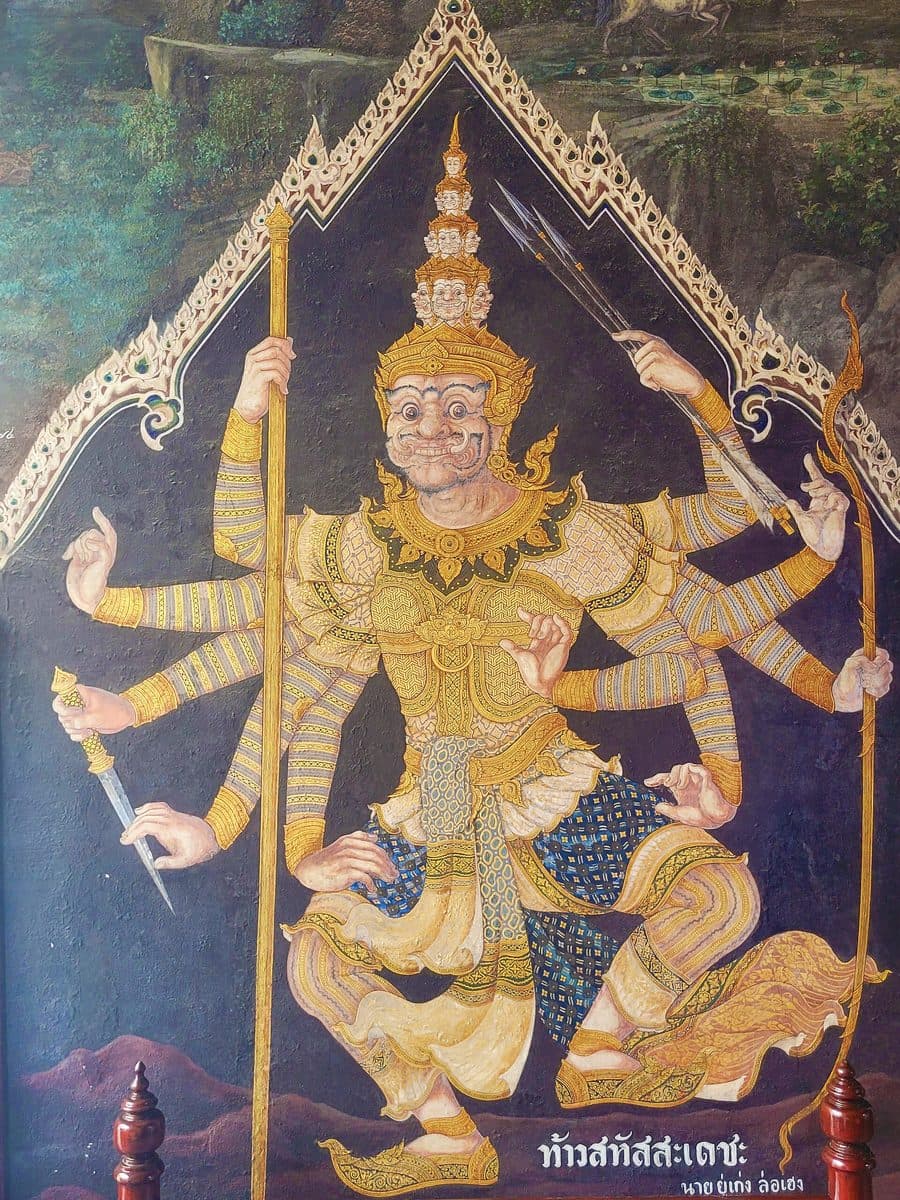
Sahasadecha, from the Ramakien murals
Unrecorded painters · 18th century, repeatedly restored
- Maker
- Unrecorded painters
- Date
- 18th century, repeatedly restored
- Medium
- Mural with gold leaf
- Collection
- Ramakien Gallery, Wat Phra Kaeo, Bangkok
- Photograph
- Ranga Sai · CC0
- Licence
- CC0
- Source
- Wikimedia Commons
Sahasadecha, a giant with a thousand faces, on a temple wall that has been repainted for two centuries.
The Ramakien is the Thai telling of the Ramayana, and the version painted around the cloister of Wat Phra Kaeo in Bangkok runs to one hundred and seventy-eight panels — a continuous mural wrapping the courtyard of the temple that houses the Emerald Buddha.
This panel comes from the war chapters and shows Sahasadecha, a giant described as having a thousand faces and two thousand arms, rendered in the flattened, ornamented Thai convention where rank is signalled by crown and colour rather than by scale or perspective. Demons are green or white with tusked mouths; the divine and the royal are gold.
The murals date from the temple's foundation in the late eighteenth century, but almost nothing on the wall is the original paint. Bangkok's climate is hard on pigment, and the cloister has been restored repeatedly — substantially so under Rama III, again under Rama VII, and on a rolling basis since. The painting is therefore old and new at once: an eighteenth-century composition maintained by generations of later hands, each following the last.
That is a different relationship to authenticity than a museum has. Nobody is preserving the original brushwork. What is being preserved is the image, and the mural's continued existence depends on being repainted rather than conserved.
The photograph is by Ranga Sai, released into the public domain under CC0.