
Tibet · 5 of 15
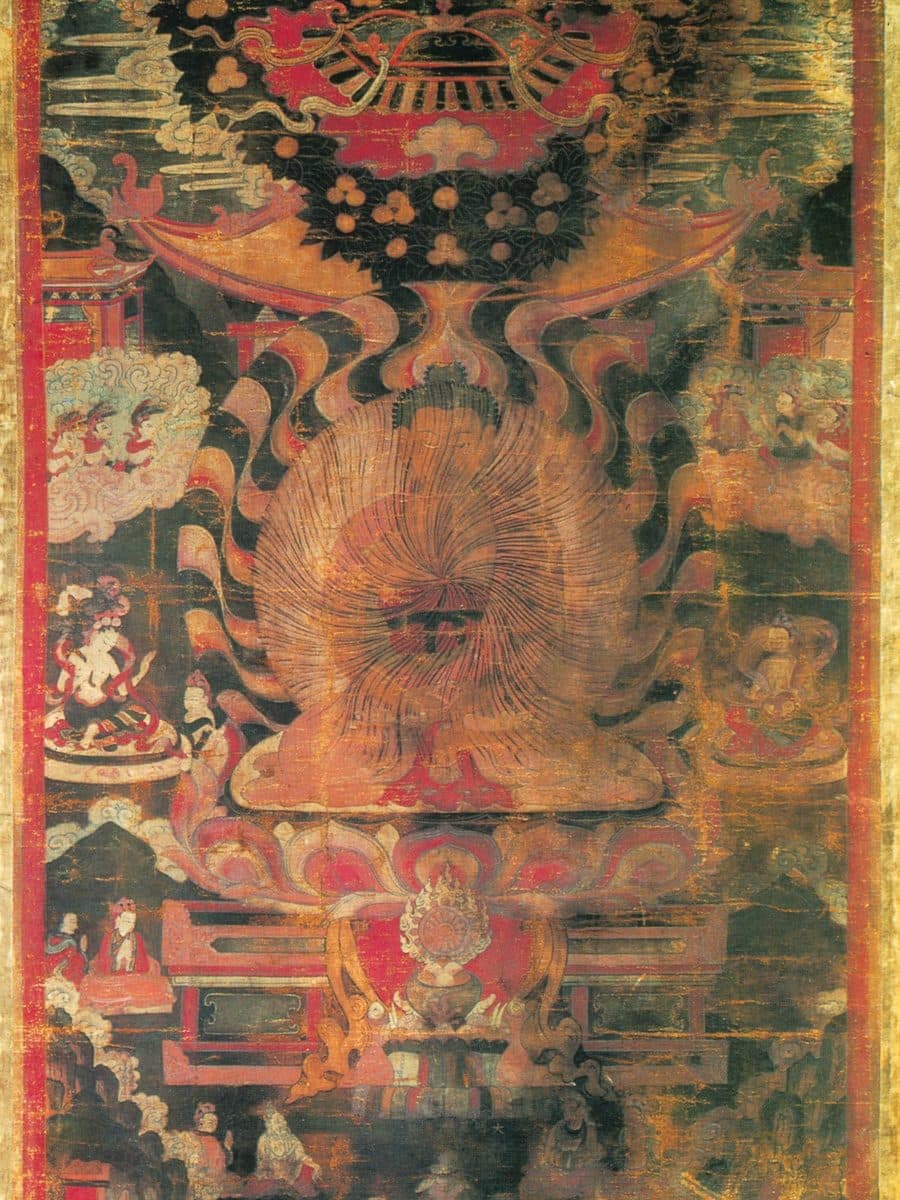
Shakyamuni Buddha with Rainbow Body
Unrecorded painter · 18th century
- Maker
- Unrecorded painter
- Date
- 18th century
- Medium
- Pigment on cotton (thangka)
- Collection
- Private collection — Himalayan Art Resources, item 31838
- Licence
- Public domain
- Source
- Wikimedia Commons
An eighteenth-century thangka of the Buddha ringed in light, painted for looking at in a particular way.
A thangka is a painting on cotton, framed in silk, made to be rolled up. That is not incidental — it is a portable devotional object, meant to travel with a teacher or a household and be unrolled when it is needed.
This one shows Shakyamuni, the historical Buddha, encircled by bands of rainbow light. The rainbow body is a specific idea rather than a decorative halo: in Dzogchen teaching it describes what is said to happen to a fully realised practitioner at death, the physical body dissolving into light rather than being left behind. Painting the Buddha this way is a statement about attainment, not a flourish.
The construction is tightly governed. Thangka painting works to proportional systems that specify the geometry of a Buddha's body before the brush touches the cloth, which is why figures across centuries and workshops are recognisably the same figure. Invention happens in the landscape, the palette, the subsidiary scenes — not in the central form.
The pigments are mineral ground into binder, with gold used for line rather than as a field, and the effect in low light is that the gold moves as the viewer does.
The painter is unrecorded, which is normal here — thangka painting is a devotional craft with a lineage, and signing was not the convention. The work is in a private collection and catalogued by Himalayan Art Resources as item 31838, which is the entire paper trail it has.