
Cambodia · 3 of 15
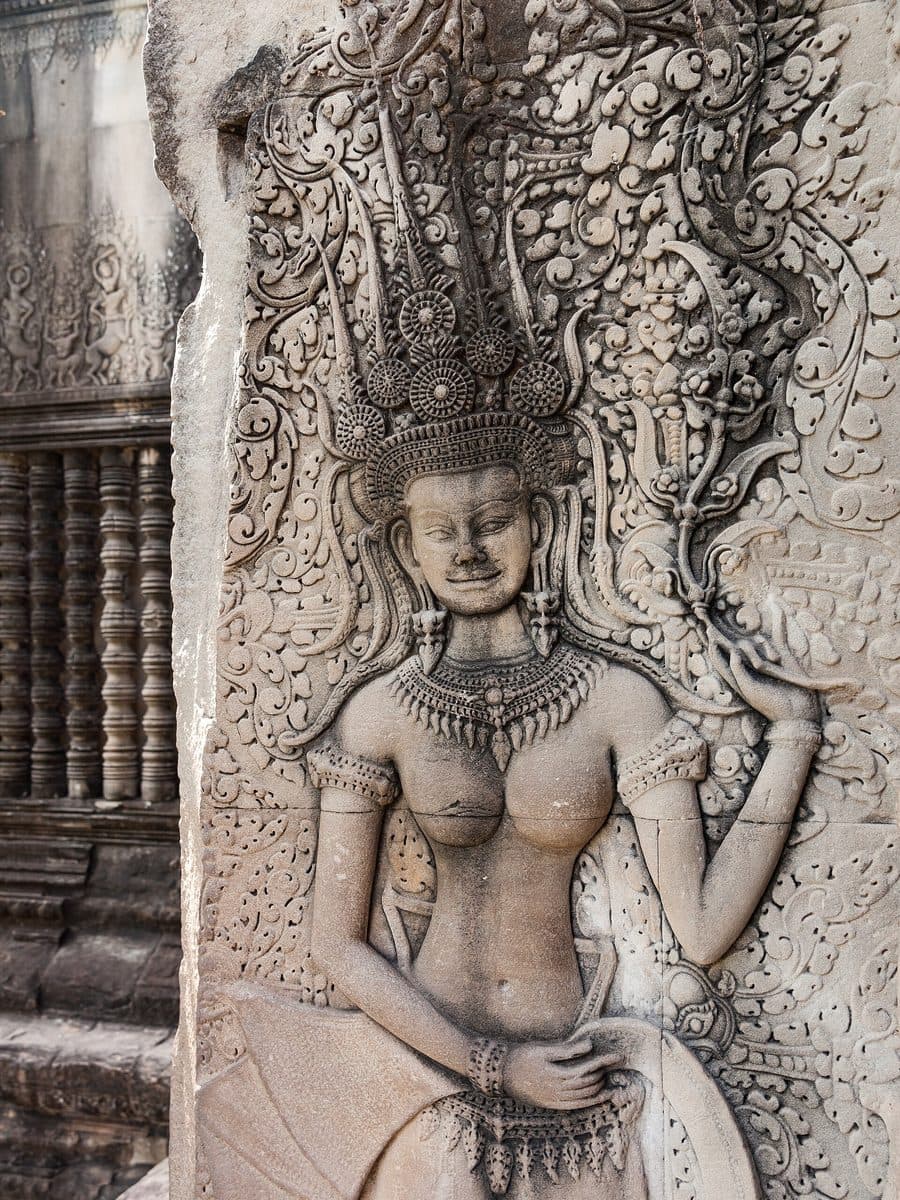
Devata relief, Angkor Wat
Unrecorded Khmer sculptors · 12th century
- Maker
- Unrecorded Khmer sculptors
- Date
- 12th century
- Medium
- Sandstone relief
- Collection
- Angkor Wat, Siem Reap
- Photograph
- CEphoto, Uwe Aranas · CC BY-SA 3.0
- Licence
- CC BY-SA 3.0
- Source
- Wikimedia Commons
One of roughly two thousand guardian figures carved into Angkor Wat, and no two of them alike.
Angkor Wat was raised in the early twelfth century under Suryavarman II as a temple to Vishnu, and later became a Buddhist site without being torn down for it — a continuity unusual enough to be worth stating plainly.
Across its galleries and towers stand devata: female figures carved in relief into the sandstone, attending the temple rather than illustrating a scene. There are somewhere near two thousand of them. The remarkable thing is that they are not repeated. Headdresses, jewellery, the arrangement of the hair, the set of the mouth — the sculptors varied them figure by figure, on a building where nobody would ever have checked.
That detail says something about how the work was organised. This was not a small commission executed by one hand; it was an enormous programme, worked by many carvers over years, and somebody decided that sameness would be a failure even where it would never be noticed.
The stone is sandstone, quarried and floated to the site, and the relief is shallow — the figures stand only slightly proud of the wall, so they read by shadow. In the flat light of the middle of the day they nearly vanish. Early and late, they come forward.
The photograph here is its own work: taken in 2009 by Uwe Aranas and released under a licence that lets it travel. The carving is nine centuries old; the image of it is fifteen years old.